Meet the governed operating framework—and the multidisciplinary practice behind it.
The operating layer
Organizations do not suffer from a lack of AI tools. They suffer from fragmented knowledge, disconnected workflows, inconsistent context, and uncertainty about what AI should be allowed to do. SAIOS connects trusted knowledge, specialized capabilities, policies, business tools, and human approval into repeatable workflows.
It is
A governed coordination layer for people, AI, information, tools, and workflows.
It is not
A single chatbot, autonomous manager, vendor wrapper, or permission to automate judgment.
It preserves
Evidence, project context, institutional memory, human authorship, and accountability.
It measures
Quality, time saved, risk visibility, adoption, and value before capability expands.
Start narrow. Prove governance.
Alpha 1.0 begins with one deliberately bounded communications capability. The purpose is not to perform autonomy. It is to prove that evidence, role boundaries, review gates, and durable handoffs can produce better work without transferring accountability to a machine.
SAIOS does not replace human intelligence. It gives human intelligence a coordinated, governed, and scalable operating system.
WHY ROBERT BUILT SAIOS
SAIOS grew from decades of work across art, product design, enterprise systems, and multidisciplinary leadership.
A practice without artificial borders
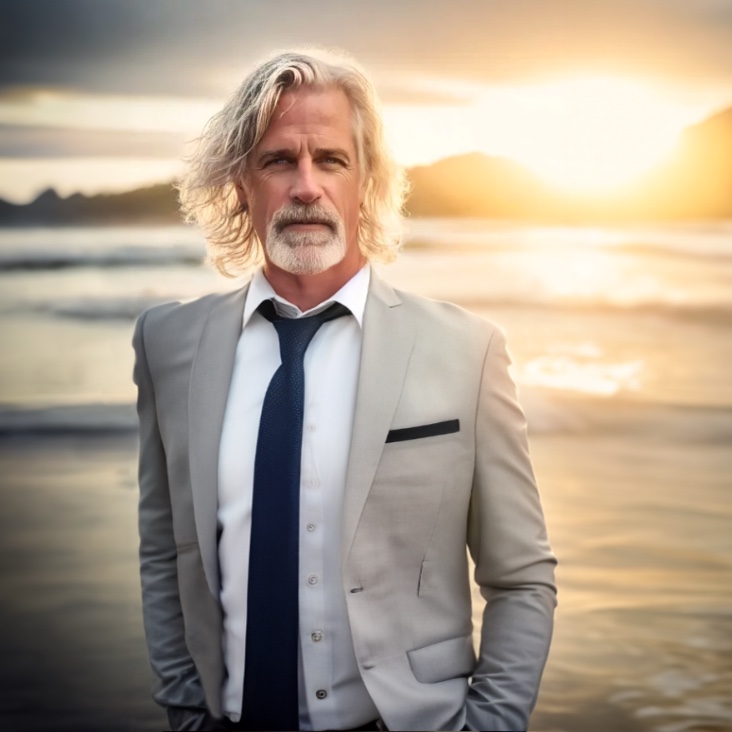
Robert Santoré is an internationally collected contemporary artist, award-winning creative director, product-design leader, technologist, and founder.
His work moves between monumental painting, sculpture, photography, enterprise digital systems, interactive installations, and governed artificial intelligence.
These are not disconnected careers.
Each discipline asks the same questions: who authored the work, whether the system behind it can be trusted, whether the judgment that shaped it stays visible, and how work actually moves from an idea to a durable, accountable outcome. SAIOS grew out of that same concern, carried into how AI-assisted work should be built.
Total capital raised by the venture/company.
Financing Robert was directly involved in.
Approximate market capitalization reached.
Creative, product, design, and experience teams led/mentored at scale.
Companies co-founded.
Creative leadership, product/UX, technology, enterprise systems, ventures, and contemporary practice.
Art, design, technology, systems, and ventures — one practice map
Painting, sculpture, photography
Product, experience, creative direction
Enterprise systems, AI, governance
Process, evidence, accountability
Company building, team leadership
One connected practice expressed across art, product design, technology, and leadership.
These are not disconnected careers — they are different expressions of the same concern with authorship, systems, judgment, and how work moves from idea to durable outcome.
Painting and contemporary practice
Santoré is known for large-format word paintings, abstract figures, sculpture, and photography.
His visual language, developed across decades of studio practice, draws from music, fashion, advertising, politics, and the cultural signals of postwar America.
The work is held in private, corporate, and museum collections internationally.
OPEN PAINTING / SCULPTURE / CV ↗Professional work, teams, companies, and ventures
Robert’s product-design practice spans strategy, research, service design, and interaction design.
It also covers visual systems, prototyping, engineering, team leadership, and enterprise transformation.
Twenty-plus years leading enterprise digital products has meant twenty-plus years leading the people who build them. Creative, product, and experience-design teams were mentored and led at scale, roughly 250 people over that time.
That same instinct for building durable structures, not just shipping individual projects, carried into company building too. Three startups were co-founded. Two went public.
Together they raised roughly $450M in capital. Robert was directly involved in a $350M financing round. At peak, combined market capitalization reached the $750M–$1B range.
Leadership, in this practice, was never separate from the creative and technical work. It is what makes the work repeatable beyond the person who first did it.
OPEN EXPERIENCE / RESUME / CASE STUDIES ↗
Interactive systems
AdhucAnima Serial Images carries a 1985 exhibition concept into a twenty-screen, 5 × 4 installation. SAIOS and ArtistAdmin extend the same systems thinking into governed AI, studio administration, provenance, and the infrastructure that allows creative work to remain durable.
Faddy Magazine USA
As Technology & Design lead for Faddy Magazine USA, Robert brings executive creative direction, user experience, and graphic design to the independent New York fashion and luxury publication led by Candice Solomon.
His contribution extends to digital production and publishing systems as well.
OPEN FADDY TEAM ↗ArtistAdmin.ai
ArtistAdmin.ai is a purpose-built operating platform for artists, studios, galleries, and collections. It brings the administrative life of a creative practice into one coordinated system—from artwork records and provenance to exhibitions, contacts, documents, and the decisions that keep a studio moving.
The platform applies the same principle that guides SAIOS: technology should strengthen human authorship and judgment while making the work around the work more durable, visible, and manageable.
OPEN ARTISTADMIN.AI ↗Why SAIOS connects these disciplines
A painting, a shipped enterprise product, and a governed AI workflow do not look alike. But each asks the same questions: who authored the work, what evidence supports it, what judgment shaped the decisions nobody sees in the final result, and whether the system behind it can be trusted to do accountable work again.
Robert’s practice has been answering those questions across studio work, enterprise systems, and company building for two decades.
SAIOS did not start as a theory about AI. It grew out of years of making things, leading teams, running systems, and watching what happens when authorship and accountability disappear. It is a coordination layer built to keep authorship, evidence, and human judgment visible instead of letting them vanish behind automation.